Why a Local Story Changes Between Its First Report and Follow-up
Compare a local story’s first report and follow-up to see what has changed, what remains unresolved and how the timeline affects your understanding.
The common mistake with a developing local story is treating its first report as the finished account. That can leave you repeating an early detail as though it still describes what happened. Comparing a local story’s first report and follow-up is less about judging which article sounds more convincing and more about seeing how the story itself has moved on.
Think of the versions as dated entries in a notebook: a later entry adds to the record, but it does not erase what readers knew earlier. The useful question is what happened between those entries, and which detail changed your understanding.
Distinguish a new fact from a later event
A follow-up may add information that was already true but not yet available. It may also report a real change that took place after the first article. Those developments can look alike on the page, but they have different implications for the timeline.
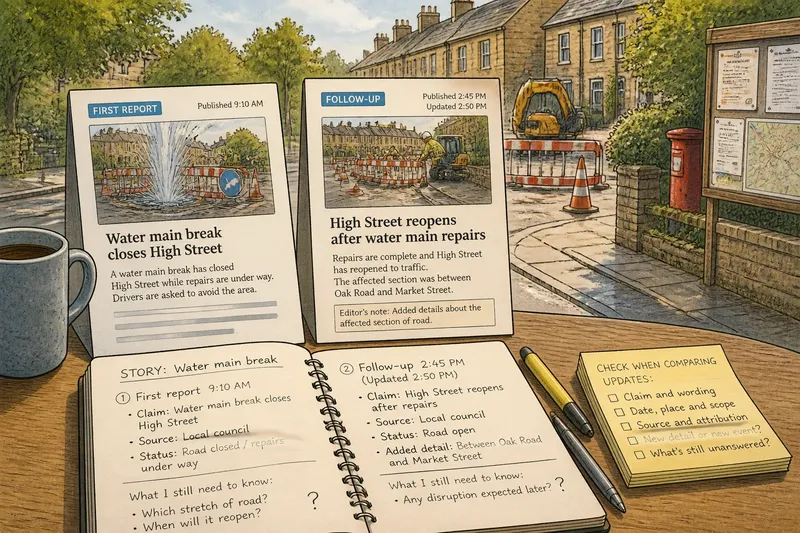
For instance, an initial report may say a road is closed after a water-main break. A later article might name the affected stretch, adding detail about the original closure. If it says the road has reopened, that describes a subsequent event; the first report may still have been accurate when published.
Sort additions into three plain categories:
- Added detail: If the later version supplies a location or name absent from the first, treat it as new context; if it changes the account of what happened, compare the wording before deciding what it means.
- Clarification: If a phrase is narrowed or explained, read it alongside the original wording; if the explanation changes the apparent claim, keep that distinction visible.
- Changed circumstance: If the article reports a later event, such as a reopening, mark it as a development after publication; if no timing is given, do not assume when the change occurred.
This distinction helps avoid calling every added detail a correction or treating a change in circumstances as proof that the earlier report was wrong.
Use publication times to rebuild the sequence
An online article may show when it first appeared, when it was updated and, occasionally, what a particular update added. These timestamps help establish what was available to readers at each point. The current page may look complete even though its first version contained less information.
Look for an editor’s note explaining the change. If there is none, an earlier link in a newsletter or a saved browser page may help you compare versions, though not every edit will be preserved. A changed timestamp alone does not tell you which sentence changed or why.
Order matters in local reporting. A meeting may be scheduled, a vote may follow, and a service may change afterwards. If an article reports only one stage, keep that limit in mind before deciding who knew what, or when.
Read revisions for changes in meaning
Small wording changes can reshape a claim. “The centre will close” gives a different impression from “the centre will close for repairs on Tuesday”. Read the relevant sentence in both versions, then check its surrounding paragraph for a new condition, time frame or decision-maker.
Verbs matter too. “The proposal passed” is not the same as “the committee recommended the proposal”; a recommendation may still need approval. If the verb changes, check whether the article explains a new decision or corrects an earlier description.
A correction notice should identify the error and provide the corrected detail. A clarification may instead explain an ambiguous phrase or add an omitted condition. The newsroom’s label is useful, but compare the actual wording rather than relying on the label alone.
Record the story’s stage, not just its latest claim
Follow-ups can add a response, a public document or a clearer timeline without answering every question. An article may establish who approved a change while leaving its effects on residents unresolved. Separate what the latest report says from what you infer from it.
Pay close attention to whether an item is a proposal, an approved decision or completed work. Approval does not establish that work has begun, just as an announcement does not prove that a service has already changed. These stages are easy to blur when updates arrive in quick succession.
For each version, make a brief record with three parts: the specific claim, who or what the article attributes it to, and its status. If a later account supplies a missing date, add that date as a new detail rather than silently rewriting the earlier entry.
Compare local story updates with a clear record
You do not need to save every version of an ordinary neighbourhood story. Keep the link, note the publication date and write down the question you still have. For a story about a road, school, meeting or local service, that small record can show whether a follow-up answers your question or simply adds context.
Say you read that a bus route may be diverted during building work. Your note says the diversion is proposed and no start date is stated. A later update reports that the transport operator has confirmed the change and published a revised map. You can now distinguish the earlier possibility from the confirmed arrangement, then check whether the map shows your stop; if it does not, the effect on your journey remains unclear.
Use these checks when comparing versions:
- If the central claim differs, compare the exact sentences; if the wording is unchanged, look for new context elsewhere in the article.
- If a date or place has changed, check whether it refers to the same event; if not, keep the two details as separate stages.
- If the article adds a document or response, note who supplied it; if the source is not named, treat that attribution as unresolved.
- If an update describes a new event, check when it happened; if the timing is absent, do not place it more precisely in the timeline.
- If the outlet labels a correction or clarification, compare the identified wording; if no label appears, describe the change without guessing its cause.
- If a question remains unanswered, write it down; if a later report addresses it, add the answer and its stated source to your record.
When another outlet covers the same development, compare the place, time and stage each article describes. One may report a single street while another covers a wider service area. Different scope can appear to be disagreement until you establish whether both accounts concern the same thing.
Why do local story updates differ?
Does a new detail mean the first report was wrong?
Not necessarily. A reporter may publish what is available and add a response or document later. Missing context can make the first account incomplete without making its stated facts false.
How can I tell whether an article was corrected?
Look for a correction notice and compare the claim it identifies with the revised wording. If there is no explanation, note the change without guessing why it was made.
Why might a headline change after publication?
A headline may be revised to reflect a decision, a clearer time frame or a development that makes the earlier wording misleading. Check the update note and article body, since the headline alone may not explain what changed.
What should I do if two outlets describe an update differently?
Check whether both reports cover the same stage, place and time, then note the source each one names. If the difference remains, leave it unresolved rather than choosing the more confident-sounding account.
Keep the timeline attached to the latest account
It is easy to remember only the latest headline and lose track of how the story developed. Keep the sequence in view: what was reported first, what was added later and what changed on the ground. That makes it easier to distinguish a correction from a routine update.
When discussing the story with a neighbour, say which version you mean: “The first report said the meeting might be postponed; the later one says it has been rescheduled.” Comparing a local story’s first report and follow-up this way keeps the timeline attached to the claim, so an update is not mistaken for a contradiction.