Before the News Feed: How Printed Local Notices Carried Information
Printed local notices made essential details visible at a glance. Learn how their layout, placement and limits shaped what neighbours could know.
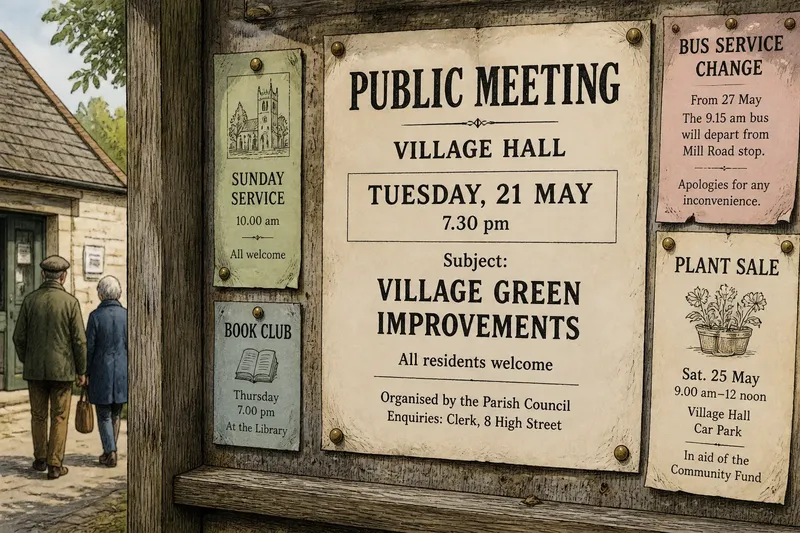
The common mistake in reading an old printed local notice is to treat it like a miniature newspaper story; the cost is missing the practical information its layout put first and the context it left out. Printed local notices were built to help neighbours spot an event, deadline or change quickly, often on a shared wall or board. To understand how they carried information, read the page as an object before treating it as a narrative.
Start with the place where the notice appeared
Imagine an invented situation: a reader comes across a notice pinned beside the entrance to a village hall. The reader first looks at its paper, position and neighbours on the board, then reads the wording. That sequence helps reveal whether it was designed for people already using the building, passers-by, or a more specific local group.
A notice displayed at a hall, shop, library or place of worship had a built-in audience. People encountered it while doing something else, so a large heading and a few clear details could matter more than a polished explanation. A printed sheet sent through homes reached readers in a different setting, where longer instructions might be practical.
Record the location if it is known, and notice whether the document was pinned, handed out, posted in a window or printed in a local publication. These methods did not reach everyone equally. A board could be useful to those who regularly passed it and invisible to people who did not.
Read the page from its strongest visual cue
Before reading every line, note what catches the eye: a bold title, a boxed date, a large word such as “meeting”, or a prominent place name. Printers and organisers had limited space and wanted the central point to register quickly. The visual order is evidence of what they considered most urgent or useful to display.
Then follow the page down. Is the event named before its time and place? Are instructions separated from background information? Does a small line at the bottom give a contact, organiser or condition? Treat the page like a noticeboard with its most important card at eye level: position guides attention, but does not tell you the whole story.
Notice how type, spacing and borders group information. A thick rule might separate one announcement from another; a larger typeface may mark a heading rather than a claim of importance to every reader. If several notices share a sheet, establish where one ends and the next begins before linking details across them.
Separate quick facts from missing context
Printed notices commonly put actionable details within easy reach: a meeting’s subject, a collection point, a service interruption or a request for volunteers. Write down what the notice states directly, such as its named organiser, venue or date. Keep each detail attached to the wording that supports it.
Next, mark what remains unclear. A notice inviting people to a “public meeting” may not say who can attend, whether a decision will be made, or what prompted the gathering. A short announcement about a changed service may identify the affected place but omit the reason. Its compact form is useful, yet it leaves readers with questions that the sheet cannot settle.
Do not turn a missing detail into a claim about what happened. If the notice names a group but not an individual, preserve that distinction. If it announces a planned action, read it as an announcement rather than evidence that the action later took place.
Look at how format shaped access
A notice could make a local fact easy to see without making it equally easy for everyone to receive. Placement favoured people who visited the site; small type could be hard to read; a sheet in one language might not serve every neighbour. Printed materials also depended on being put up, kept legible and seen before the information became outdated.
Format influenced what could fit. A small handbill might privilege a date, address and short instruction, while a column of notices in a local paper could include more explanation. Neither form automatically reached the whole community. Ask who would plausibly encounter it, what they needed to know, and what barriers the page itself suggests.
Physical condition matters too. A torn edge may have removed a line; faded ink can make a name uncertain; handwritten additions may belong to a later reader rather than the original printer. Describe what is visible and distinguish it from what you infer.
Compare the notice with its surrounding material
Once you have read the notice on its own terms, look at the page, board or bundle around it. Nearby items can show whether it appeared among routine announcements, public services, community events or appeals. That setting can clarify the kind of information being shared, but it does not prove that the notices had the same author or purpose.
If a notice was reproduced in a local publication, check its position and any heading that groups it with other material. If it survives as a loose sheet, note whether it carries a printer’s name, an issuing organisation or a date. Those clues can help identify who circulated the information and how readers might have encountered it.
Keep the comparison narrow. A nearby announcement may concern a different event, even if it uses similar wording or paper. Treat adjacency as a clue about presentation, not as proof of a connection.
What can a printed local notice tell you?
Why were notices designed to be read quickly?
Many notices had to catch attention where people were already passing through, so headings and practical details were often prominent. Their layout helped a reader decide whether the information mattered without reading a long account.
Can a notice show who received the information?
It can suggest an intended audience through its location, language and subject, but it cannot establish who actually saw it. A notice at a shared venue may have been available to visitors while missing people who seldom went there.
Does a notice prove that an announced event happened?
No: it records that information was circulated or an event was planned, not necessarily that it took place. Look for a separate account or record if you need to establish what followed.
How should you handle a damaged or incomplete notice?
Transcribe only the words you can read and mark uncertain or missing portions plainly. Do not silently fill gaps from context, even when a likely date or name seems obvious.
Build a useful reading record
For each notice, keep a compact note that separates its physical features from its message. Include:
- Form: loose handbill, wall notice, leaflet or printed column.
- Placement: the known venue or the page section where it appeared.
- Visible hierarchy: the heading, boxed details, type changes or divisions.
- Stated information: the named people or groups, place, date and requested action.
- Uncertainties: damaged wording, missing context or unclear audience.
- Surrounding material: nearby items, described without assuming they are connected.
Say you are reading an invented handbill headed “Residents’ meeting” with a time and hall address but no named organiser. You record those visible details, note that the audience appears to be nearby residents, and leave the organiser blank rather than assigning one from a neighbouring notice. The result is a concise description that preserves what the page offers and what it does not.
Use the format as evidence, not as a complete account
Printed local notices show how communities made selected information visible: through a heading, a placement, a few details and a material form suited to a particular setting. Read those choices carefully, and the page becomes more than a scrap of text. It also becomes a record of how information was presented to its intended readers.
When you return to printed local notices, keep one distinction in view: a notice can tell you what someone wanted neighbours to see at a glance, while leaving unanswered who saw it and what happened next. That boundary is useful, not a flaw to repair by guesswork.