A Weekly Reading Habit for One Ongoing Local Story
A weekly reading habit for one ongoing local story helps you track new developments, distinguish scheduled events from decisions and know when to stop checking.
The common mistake with an ongoing local story is to reread the latest headline without checking whether it changes anything. That can make a scheduled meeting sound like a decision, or leave you searching long after the next useful update. A weekly reading habit for one ongoing local story can instead give you a simple way to check for a specific event and decide whether another visit is needed.
Keep the routine focused on one story and its next stated milestone. Rather than building a running account of every mention, use a short note to record the milestone, where to check for it and what action its outcome calls for.
Anchor your routine to the next stated milestone
Imagine a local paper reports that a council has asked staff to review the opening hours at a library branch. The report says the council expects to discuss staff options at a future meeting, but it gives no decision date. If you use the branch, the next useful thing to watch for is not every article about the library; it is a dated agenda, meeting or report that clarifies the review.
Write down the exact next event named in the report, if there is one. If no event is named, make that the uncertainty: “No next meeting or report date stated.” Add the outlet, publication date and a link or saved copy so you can return to the original wording.
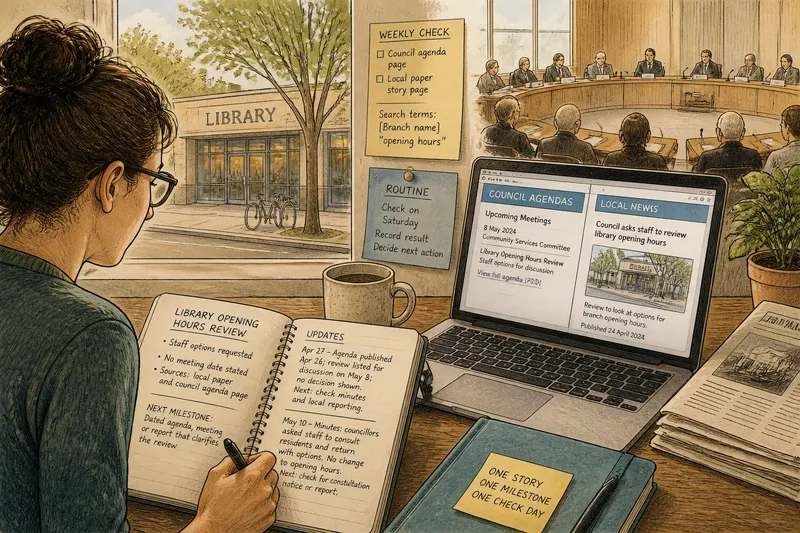
A short note could read: “Library hours review; council asked staff for options; next meeting date not stated; check the council agenda and the local paper.” It works like a calendar reminder: it points to the next useful place to look without asking you to keep the whole story in your head.
Check for the event, not for a constant stream
Choose one regular day to look at the sources most likely to report the milestone. For a council matter, that might mean the council’s meeting agenda page and the local outlet’s story page. Search with the same plain terms each time, such as the branch name and “opening hours”, so you can tell whether a result is genuinely new.
Record what you checked and the date. If there is no new agenda or dated report, note that result and wait for the stated event or a new date rather than repeatedly searching during the week.
Say you have a note about the library review and, on your chosen check day, find a council agenda dated that morning. It lists the review for discussion but does not set new hours. You record “discussion scheduled; hours undecided” and plan to check the published minutes or a follow-up report after the meeting. The routine has produced a clear next action without turning an agenda item into an outcome.
Use each update to choose the next action
When an item appears, ask what it changes about the next milestone. A useful entry can be as brief as: “Checked Saturday; agenda published Friday; discussion listed; no decision recorded; check minutes after meeting.” This makes the note a working prompt rather than a second version of the article.
Different outcomes call for different next actions:
- If an agenda gives a meeting date, record it and check for minutes or reporting after that meeting; if it gives no date, keep the item open and check the relevant agenda page on your chosen day.
- If minutes record a decision, note the decision and mark the original question answered; if they only record discussion, leave the question open and look for the next stated report or meeting.
- If a report says staff are consulting residents, note where and when the consultation is available; if it gives no details, do not infer that the consultation is complete and look for a dated council notice.
- If two local outlets report different details, note which outlet says what and check the primary document if one is linked; if neither provides a document, keep the difference unresolved.
- If a headline reappears without a new date or information, leave the note unchanged; if the linked article has been updated, read the update and record only what has changed.
- If the council says the item is withdrawn or closed, record that status and stop routine checks; if the status is unclear, seek a dated notice or ask the relevant council office for clarification.
Keep your wording factual and narrow. “Consultation reported as complete; no vote reported” is more useful than “the council is about to decide”, which predicts an outcome the available item may not support.
When should you check again?
What counts as a useful update?
A useful update has a clear date and a direct bearing on the milestone or question in your note. A recycled headline without a new document, event or detail does not call for a new entry.
What if the promised event does not appear?
Check the relevant source on your usual day and record that you did not find the event there. If the original report named an office or contact, you can ask whether the timetable has changed; otherwise, leave the question open rather than guessing.
Should you follow more than one outlet?
Use another local outlet if it adds reporting on the same milestone, and record which outlet published each detail. When a council agenda, minutes or notice is available, distinguish that primary document from a news report describing it.
When can you stop checking?
Stop the regular routine when the question is answered, the council formally closes or withdraws the item, or no next event remains to follow. Keep the note for reference if useful, but do not treat an unresolved story as a reason to search indefinitely.
Work through a full check without guessing
Imagine your starting note says: “Library opening hours review; staff options requested; no meeting date stated; sources: local paper and council agenda page.” On your chosen Saturday, you search the branch name and “opening hours” on the paper’s site, then check the council agenda page. The paper has no new report, but the agenda lists the review for a meeting on a stated date.
You update the note: “Agenda published Friday; review listed for discussion; no hours decision shown; check minutes and local reporting after the meeting.” After that meeting, suppose the minutes say councillors asked staff to consult residents and return with options, without recording a change to opening hours. You add that result, leave the central question open and make the next check conditional on the promised return of options. Each step uses a dated item, and the resulting answer is precise: discussion took place, consultation was requested, and the schedule remains undecided.
A weekly reading habit for one ongoing local story is most useful when the next check follows a stated event, not a headline’s urgency. That small distinction helps you spend attention where it can clarify the story, and leave the rest until there is something concrete to read.